If that opening quote sounds familiar, you’re in good company.
a week, over 20% of a manager’s time, goes on employees’ personal and emotional concerns. Gartner, 2026.
The stress is real, too: 71% of leaders say theirs has risen significantly in their current role, and 40% have considered leaving leadership altogether (DDI, 2025).
Much of the stress comes from a particular mistake: spending energy on things nobody in the room can change, while the things you could change this week stay undone. Or the twin of it: trying to fix all of it, personally, until you burn out.
The cure is a sort. Three piles, fifteen minutes.
The three rings
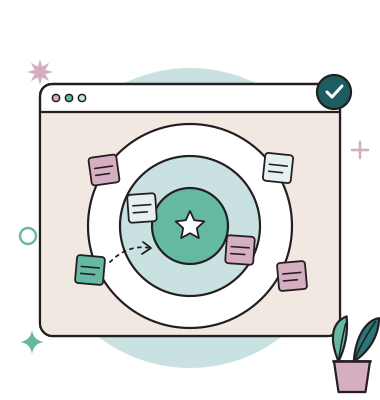
Picture a target with three rings.
- The centre is Control. Things you can change yourself, this month, without asking anyone. The move is Act.
- The middle ring is Influence. Things you don’t decide but have a real voice in. The move is Ask: make a reasoned case to the person who decides.
- The outer ring is Accept. Things outside your reach for now. The move is Adapt: stop fighting it, plan around it, and tell people straight.
Outside the target sits a fourth box: Signpost. Someone’s health, legal process, formal investigations and safeguarding aren’t yours to handle alone. Hand the process to HR, occupational health, Acas or an employee assistance programme. Keep the human side.

The Manager’s Control Map
Act on what you control, ask about what you can influence, adapt to what you must accept, and don’t confuse the three. Three rings, fifteen minutes, solo or with your team.
This idea isn’t new. “Control, influence, accept” circulates among practitioners, and Stephen Covey’s circles of concern and influence will be familiar. What we’ve added is the evidence underneath each ring, a map of what usually sits where for a UK line manager, and a way to measure it. Nobody has trialled our version, so treat it as a memory aid, not a proven method.
What usually sits where
Every organisation differs, so treat these as starting positions.
Control (Act): your own behaviour and tone; how your meetings run; feedback; goals with your team; who gets stretch work; recognition; how you explain decisions, including ones you didn’t make; one-to-ones; your out-of-hours messages.
Influence (Ask): upstream workload and deadlines; headcount; pay and promotion recommendations; cross-team processes; tools and training time; how company policy is applied locally; other people’s behaviour, including your boss’s.
Accept (Adapt): company strategy; pay bands; the market and the economy; law and regulation; decisions already made above you, for now; the past.
Two notes. Items often straddle rings, so split them. “The pay freeze” is Accept. “How I tell the team about it” is Control. “Leanne’s regrade case” is Influence. And “for now” matters: a pay band can shift after a well-evidenced regrading case.
The 15-minute exercise
- Dump (3 minutes). List everything worrying you or eating your energy this week. One line each, eight to twelve items.
- Sort (4 minutes). Put each in Control, Influence, Accept or Signpost. Split anything that straddles two rings.
- Challenge (3 minutes). For every Accept item ask, “Is any part of this mine to influence?” For every Influence item ask, “Is any part of this mine to control?” Move items inward where that’s honest. Then check the other way: “Am I trying to control something that’s really someone else’s call, or someone else’s behaviour?”
- Pick three moves (4 minutes). One Act, with a time, a place and a first physical action. One Ask, with a named person, a reason in their terms and a date. One Adapt: what you’ll stop spending energy on, and the sentence you’ll say to the team.
- Diary it (1 minute). Put the Act and the Ask in the calendar. Redo the map in a month.
A worked example (fictional)
Marcus leads a nine-person customer billing team at a fictional regional water company. The annual price rise has pushed call volumes up. Head office is moving to a new billing system in January. A pay freeze and hiring freeze have just been announced. His most experienced agent, Leanne, is quietly taking all the complex complaints. Two agents are rowing about who handles escalations. Marcus has been working until 8pm and messaging the team at night.
His sort:
- Control: who handles escalations; how Monday’s meeting runs; Leanne’s load; coaching for the new starter; how he explains the pay freeze; his own 8pm messages.
- Influence: temporary cover for the January go-live; training time; Leanne’s regrade through the grading review.
- Accept, for now: the pay freeze; the price rise; the choice of billing system; the hiring freeze this quarter.
On the challenge step he spots three things. Leanne’s regrade isn’t the pay freeze. It’s a role change that goes through the grading review, so it’s Influence. Training time and floor-walkers for the go-live aren’t the system choice, so also Influence. And the escalation row isn’t a personality clash he can’t fix. Who handles escalations is a decision he owns.
His three moves:
- Act: “If it’s Monday at 9, I publish the escalation rota and the rule for goodwill credits.” And scheduled-send from tonight.
- Ask: to his own manager, by Wednesday, in her terms: “First-contact resolution is the number we’re judged on this quarter. Calls are up, and the last time we changed systems, handling times rose for about six weeks. Two temporary agents for eight weeks from go-live would protect the number. Could we agree it by the 31st?”
- Adapt: what he said at Monday’s meeting.
I want to be straight with you about the pay freeze. It’s company-wide, I can’t change it, and I’ve stopped arguing it every week, because it was taking time I should have been spending on you. Here’s what I can do. Leanne’s role has changed a lot this year, so I’ve put her case into the grading review, and I’ll tell you all when I hear. And from today, this meeting is for things we can change. If something’s bothering you that we can’t change, tell me in your one-to-one, and I’ll take it up the line once, properly, and come back to you with the answer.
Four weeks later the escalation row had cooled, his manager had agreed one temporary agent (not two) and protected training slots, so the Ask partly worked, which is normal. The Monday meeting was 20 minutes shorter and the evening messages had stopped.
Four rules
- Start in the centre. Before you push upward, do everything in your own ring. Your own behaviour is strongly linked to your people’s wellbeing and trust.
- Ask directly. A reasoned case is the best-supported influence tactic, and people underestimate how often a direct request gets a yes.
- Accept is not silence. Name it, make the case once if it matters, tell the team where it stands, and plan around it. Then stop re-arguing it every week.
- Hand it in. One of the most useful uses of the map is widening your team’s own centre ring, by handing over decisions where the work happens.
Watch-outs
- Accept as an excuse. “Not my problem” is the way this tool is most likely to be misused. Rule one is start in the centre.
- Putting other people in your Control ring. You can’t control another adult. You control the standard, the conditions and your response. Their behaviour is Influence at best.
- Saying “just focus on what you can control” to someone in distress. It sounds dismissive when it comes too early. Listen first, offer the map later, and signpost where needed.
- Using it to dodge legal duties. Health and safety, reasonable adjustments and preventing harassment aren’t optional because they feel like someone else’s job.
What the evidence says, and how sure we are
- Strong, correlationalEmployees who feel more control at work report more satisfaction and motivation, and less strain, absenteeism and intention to leave (Spector, 1986). The popular claim that control “cancels out” heavy demands is weak: a large review found the buffering effect very weak overall (Häusser et al., 2010). Control helps in its own right. Buffering is contested.
- StrongTransformational and destructive leadership were the strongest predictors of follower mental health, in opposite directions and of similar size (Montano, Schleu and Hüffmeier, 2023). Correlational.
- StrongFairness, explanation and respect from a manager go with trust in that manager (Colquitt et al., 2013).
- StrongRational persuasion was the only influence tactic whose positive link with outcomes held across every moderator tested, and pressure was consistently negative (Lee et al., 2017). Whether that holds for upward requests for resources hasn’t been tested.
- Moderate, one studyIn a two-wave study of 412 UK customer service workers, acceptance predicted better mental health and performance a year later, over and above job control (Bond and Bunce, 2003).
- Strong, mostly labOf the ways people manage emotion, rethinking the situation and taking someone else’s perspective worked best. Suppressing the feeling did nothing (Webb, Miles and Sheeran, 2012).
- Emerging, contested overallMatching the move to the ring has partial support from small studies. The clearest signal is that focusing on what you can control right now goes with less stress (Person and Frazier, 2024).
- UntestedThe Control Map itself. The parts have evidence. The packaging hasn’t been tested.
Frequently asked questions
What if my boss is the problem?
You can’t control another adult, so a boss’s behaviour sits in Influence. You can name the behaviour, set a standard, keep a dated factual record, confirm agreements in writing, and make the case in terms of their goals. If it’s bullying or harassment, go to HR and your formal grievance route. Leaving is a legitimate option.
What if I’m burnt out?
Burnout is classified by the World Health Organization as an occupational phenomenon, not a medical condition, so treat it as a signal about the job rather than something to diagnose. Map what’s draining you and fix one thing this month. If your health is affected, talk to occupational health or your GP.
Can I use this with my team?
Yes. It takes 15 minutes. Everyone writes what’s getting in the way, silently, before anyone speaks. Sort together into control, influence and accept. Time-box the Accept column: one sentence per item, no debates. Pick one Act the team owns, one Ask you’ll take up the line, and one Adapt the team agrees how to talk about.
Isn’t this just “focus on what you can control”?
It overlaps, but it adds a middle ring for what you can influence, which is where most of a manager’s room to move is, and a signpost for things that aren’t yours to handle alone.
Sources
- Gartner (2026), on manager time spent on employees’ personal concerns.
- DDI (2025), on leader stress.
- Spector (1986), on perceived control at work.
- Häusser, Mojzisch, Niesel and Schulz-Hardt (2010), Work & Stress, on the job demand-control model.
- Montano, Schleu and Hüffmeier (2023), on leadership and follower mental health.
- Colquitt et al. (2013), on fairness and trust.
- Lee et al. (2017), on influence tactics.
- Bond and Bunce (2003), Journal of Applied Psychology, on acceptance and job control.
- Webb, Miles and Sheeran (2012), on managing emotion.
- Person and Frazier (2024), Anxiety, Stress, & Coping, on coping and perceived control.